
Room-Temperature Phosphorescence in Amorphous Films - and How to Actually Make It
FOR MATERIALS SCIENTISTS
If you design functional organic molecules - for OLEDs, sensors, security inks, solar cells, or bioimaging - you may encounter a problem: synthesis planning is a bottleneck that slows down every design iteration and testing. We used a novel room-temperature phosphorescent molecule from the Max Planck Institute as a test case for our computer-aided synthesis planning software ChemAIRS: a new structure with no synthesis methods precedent in the literature. This is what ChemAIRS returned.
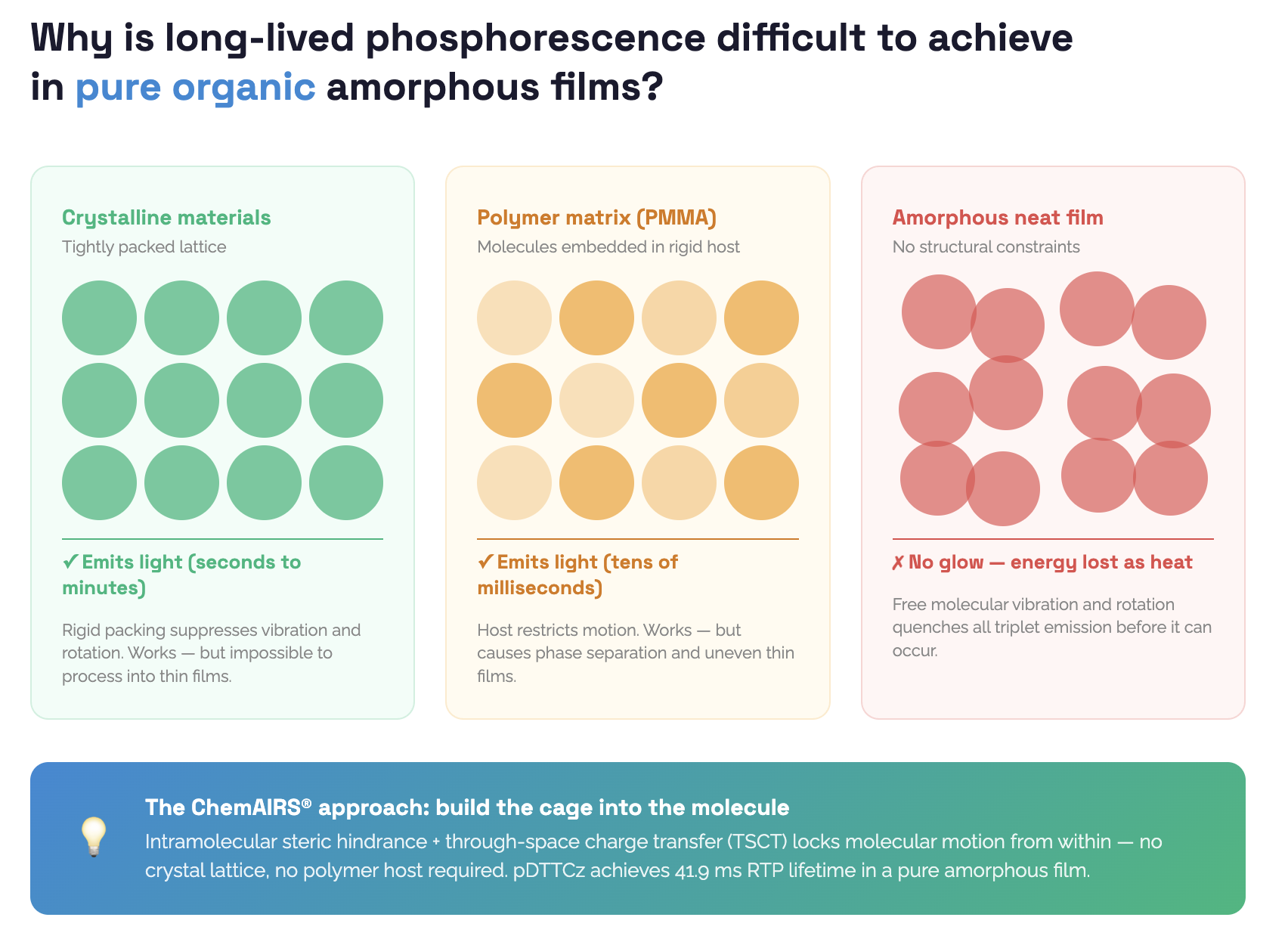
Figure 1. The three traditional approaches to organic phosphorescence - and why amorphous neat films have always been the hardest.
The Stubborn Problem with Amorphous Thin Films
Room-temperature phosphorescent (RTP) materials are one of the most actively pursued targets in organic materials science.. A pure organic film that keeps emitting light after excitation stops has potential applications across multiple industries:
OLEDs and optoelectronic devices - long-lived triplet emitters without costly heavy metals
Anti-counterfeiting and security printing - time-encoded labels that reveal information within a specific window after UV excitation
Bioimaging and sensing - time-gated detection that eliminates background fluorescence noise
Data encryption - patterns invisible to the eye seconds after excitation
But making these materials work in amorphous thin films - the format devices actually require - has been a stubborn problem. Organic molecules in amorphous films vibrate and rotate freely at room temperature, losing excited-state energy as heat before light can be emitted. Every workaround had a manufacturing trade-off:
Crystalline materials work - but are incompatible with thin-film device fabrication
Rigid polymer matrices work - but cause phase separation and film inhomogeneity that kills device performance
A team from the Max Planck Institute for Polymer Research, publishing in Advanced Optical Materials, addressed this. Their strategy - intramolecular steric hindrance combined with through-space charge transfer (TSCT) - achieves long-lived phosphorescence from within the molecule itself; no external constraints needed.
This design principle - building rigidity into the molecule rather than relying on the environment - is a general strategy applicable across organic functional materials. The same logic applies wherever you need to stabilize an excited state in a processable film.
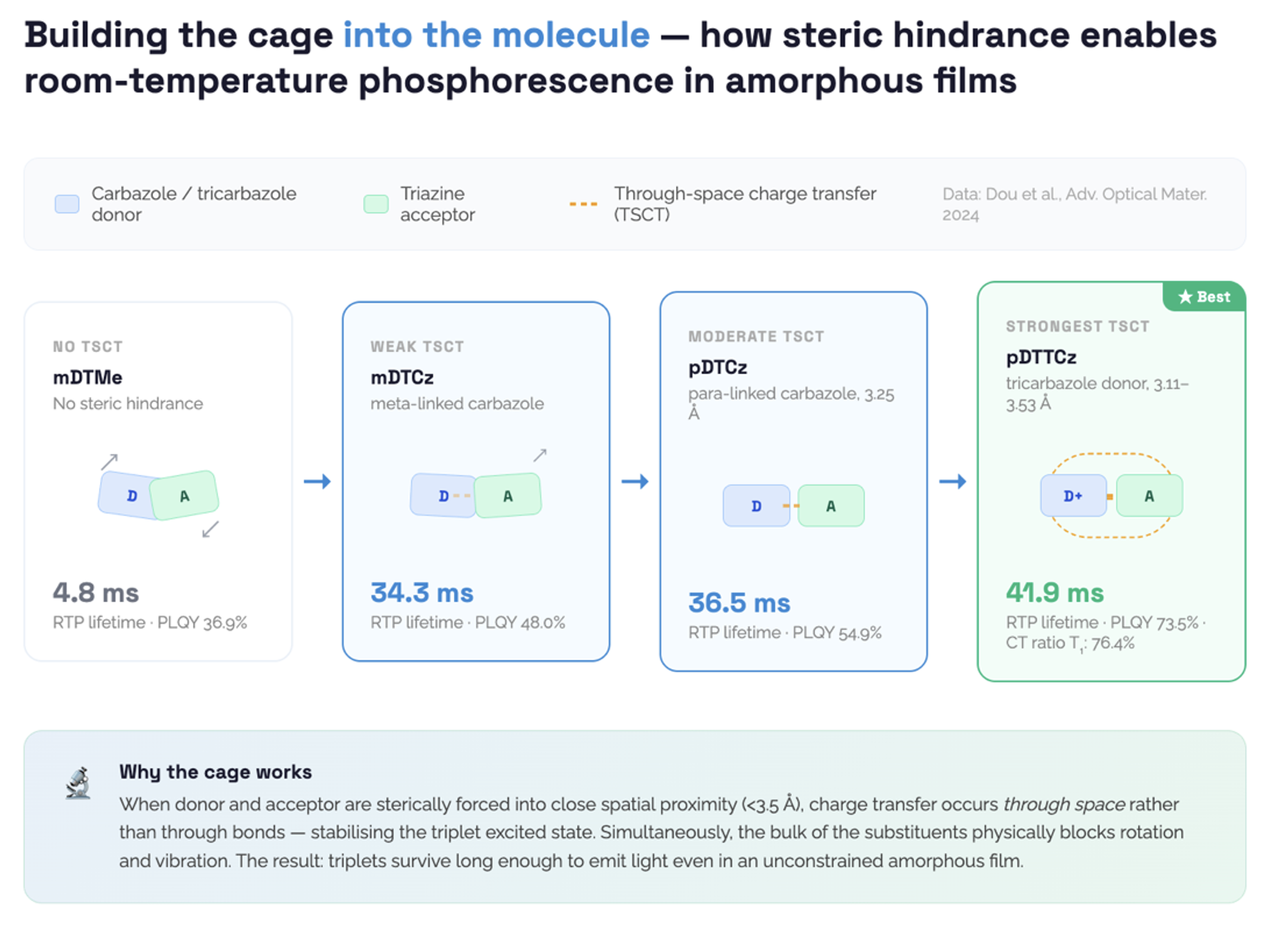
Figure 2. How increasing intramolecular steric bulk - from mDTMe to pDTTCz - progressively enables through-space charge transfer and suppresses nonradiative decay.
The Design Strategy: Steric Hindrance + TSCT
The research team designed four carbazole-triazine molecules - mDTMe, mDTCz, pDTCz, and pDTTCz - systematically increasing steric bulk and tuning donor-acceptor geometry across the series.
The key insight: when donor and acceptor groups are forced into close spatial proximity (3.1–3.5 Å) through geometric confinement, charge transfer occurs through space rather than through covalent bonds. This TSCT interaction does two things simultaneously:
Stabilizes the triplet excited state by giving it partial charge-transfer character - making radiative decay competitive with nonradiative loss
The steric bulk itself physically blocks the molecular rotations and vibrations that would otherwise quench emission
The result across the series is striking. As steric hindrance increases from mDTMe (no TSCT) to pDTTCz (strongest TSCT), every photophysical metric improves - RTP lifetime, quantum yield, and ambient-condition stability.

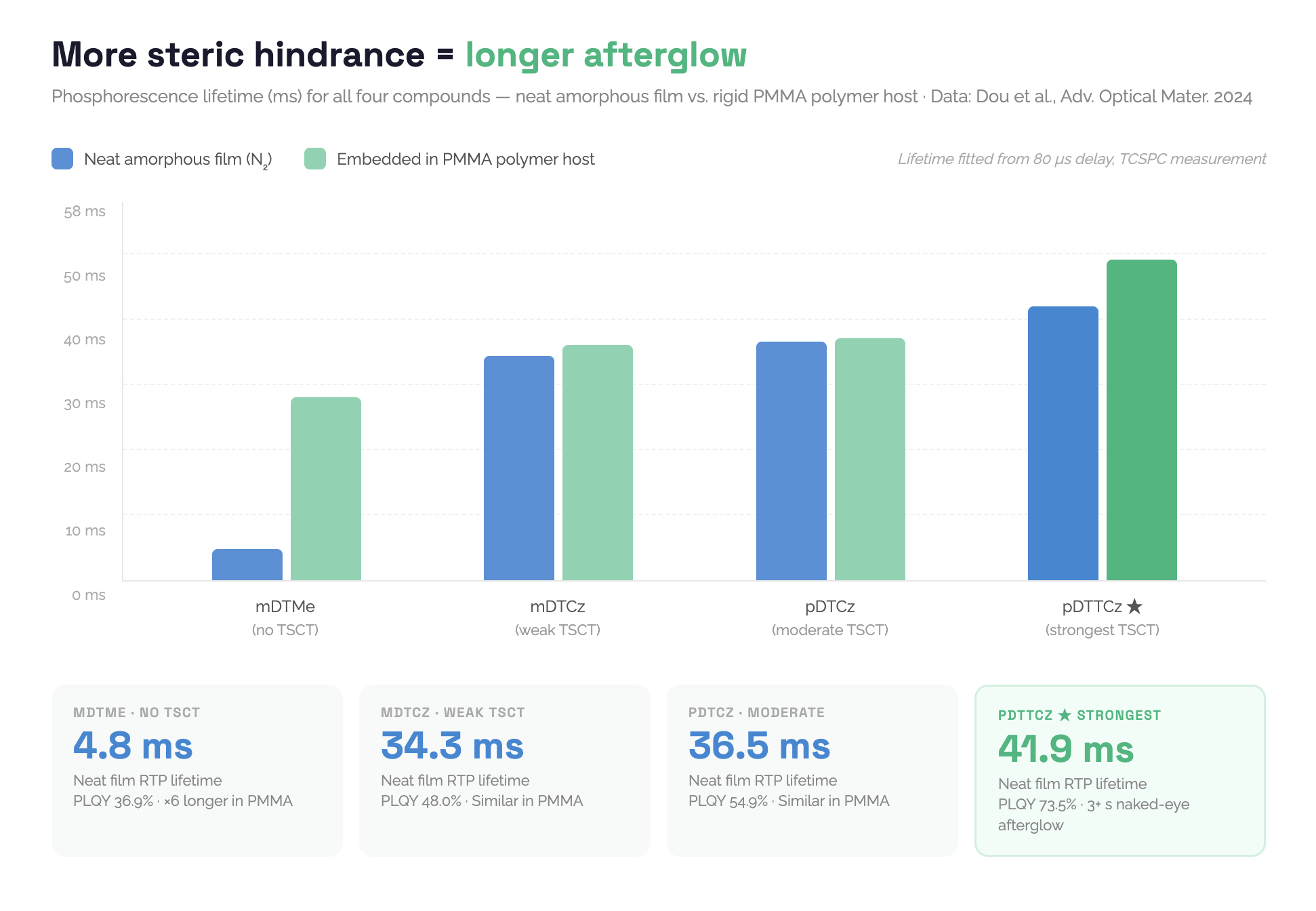
Figure 3. RTP lifetime comparison across all four compounds - neat amorphous film (blue) vs. PMMA polymer host (green). Notably, pDTCz and pDTTCz neat films perform almost as well as the polymer host, confirming the intramolecular mechanism is doing the work. Data: Dou et al. 2024.
Critically, pDTCz and pDTTCz in neat amorphous films achieve lifetimes within a few milliseconds of their PMMA-embedded counterparts - confirming that the intramolecular mechanism is doing almost all of the work that was previously outsourced to the rigid host.
For materials scientists, this is the meaningful result: molecular design alone can replace external constraints, opening the door to device-compatible amorphous films with long-lived triplet emission.
Synthesis Planning for room-temperature phosphorescent (RTP): Where ChemAIRS Comes In
Given pDTTCz - the highest-performing compound - as the target, ChemAIRS generated multiple complete synthetic routes from commercially available starting materials. Not theoretical disconnections, but full sequences with real reagents, realistic conditions, and sourcing data for every intermediate. Two routes stood out:
Route 1: Early Triazine Introduction
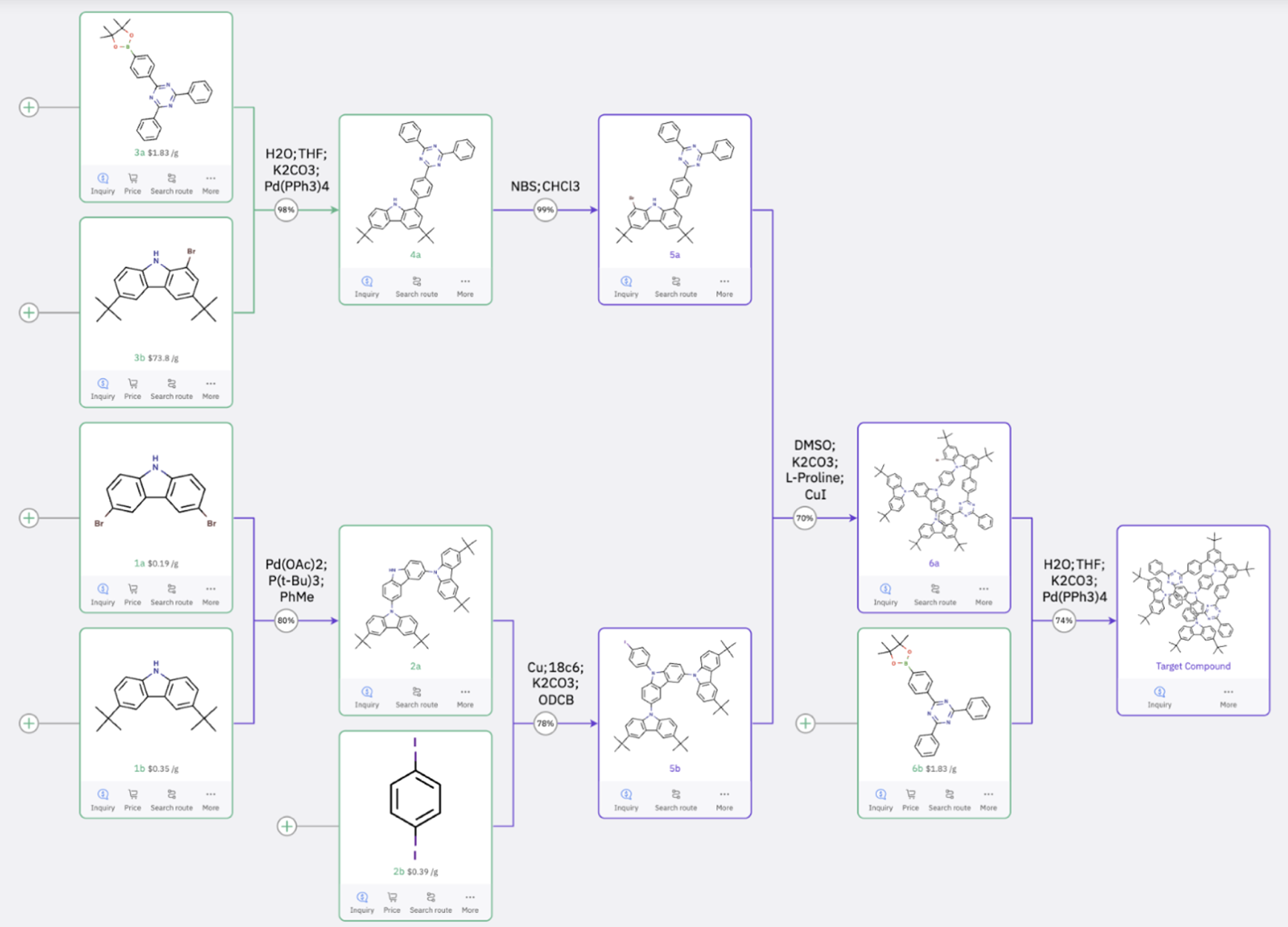
Figure 4. Modular assembly of pDTTCz (Target Compound) via a series of Suzuki–Miyaura, Buchwald–Hartwig, and Ullmann–Goldberg Couplings
A modular assembly strategy that introduces one of the triazine “arms” early and converges fragments late (Figure 4). ChemAIRS identified:
Suzuki–Miyaura cross-coupling between a commercial triazine boronate ester (3a) and a carbazole derivative (3b) to build the triazine-aryl fragment 4a
Buchwald–Hartwig amination to construct the tricarbazole scaffold 2a from dibromocarbazole precursors 1a and 1b
Ullmann–Goldberg couplings to unite the two fragments (6a)
A final Suzuki–Miyaura step to install the second triazine group
Every starting material in this route is commercially available. The modular structure means any fragment can be swapped independently - change the donor, adjust the linker, modify the acceptor - without redesigning the entire synthesis.
Route 2: Late-Stage Double Suzuki Cross-Coupling
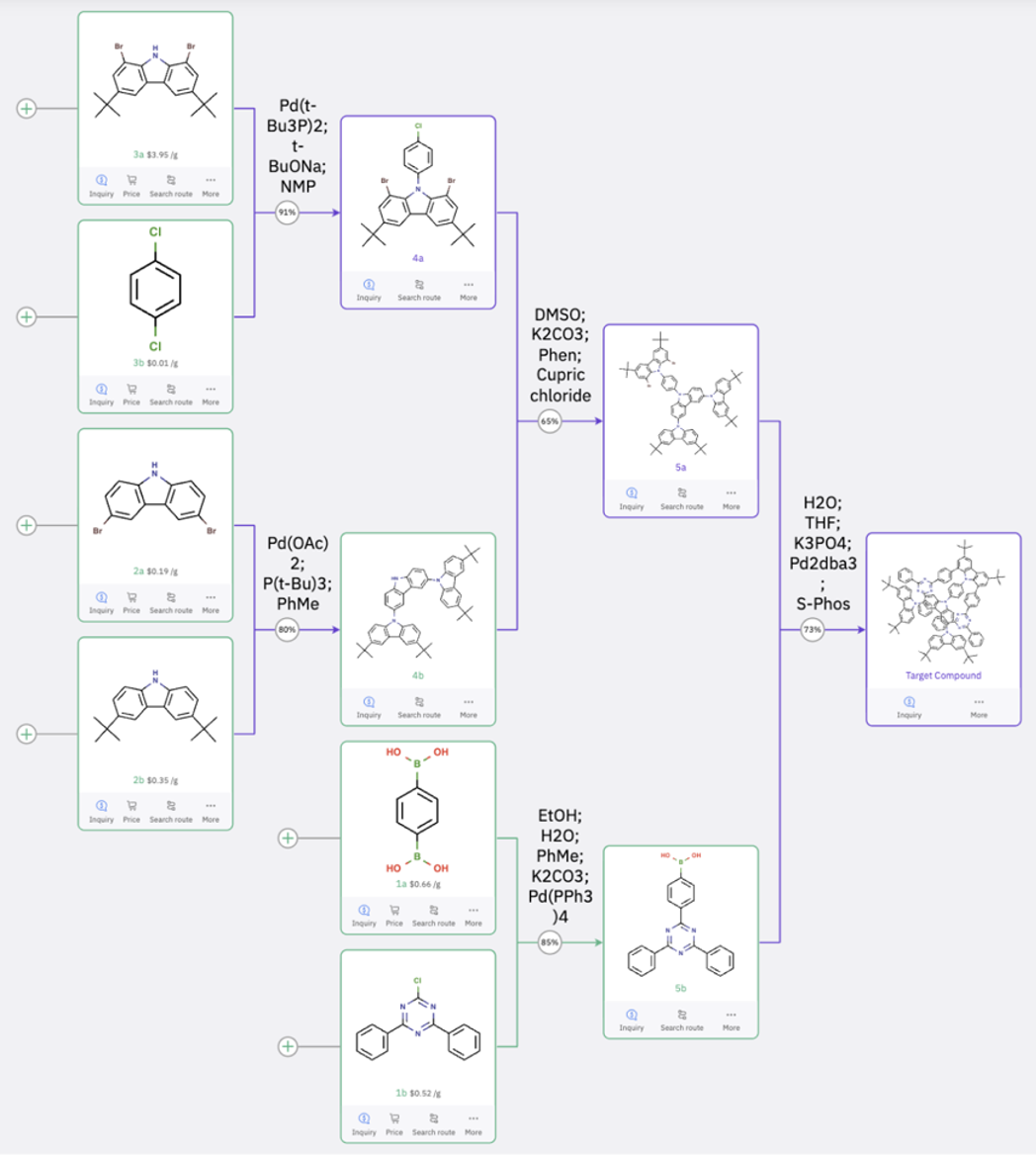
Figure 5. A convergent route to pDTTCz (Target Compound) relying on a double Suzuki cross-coupling reaction in the final step
A highly convergent approach that defers the most demanding bond-forming step to the end (Figure 5). Two donor scaffolds (4a and 4b) are built in parallel via Buchwald–Hartwig aminations, united via Ullmann–Goldberg coupling into the key dibromide 5a, then a double Suzuki cross-coupling installs both triazine arms simultaneously.
This route's final step uses conditions nearly identical to those in the published synthesis - a direct validation that ChemAIRS identifies chemically realistic pathways, not just plausible disconnections. Fewer steps, less waste, lower cost per gram.
The materials science advantage: ChemAIRS doesn't just find one route and stop. It maps the synthetic landscape - giving you options to compare on step count, cost, commercial availability, and scalability. For functional materials development, where you're often making a series of structural variants, this means every new target gets a full route analysis in hours rather than days.
Retrosynthesis for OLEDs, RTP Emitters, and Functional Dyes: AI Synthesis Planning Beyond Pharma
ChemAIRS was built for any complex organic target - not just pharmaceutical compounds.
Materials scientists designing functional molecules face the same core synthesis planning challenges as medicinal chemists. The person who designs the molecule is usually also responsible for figuring out how to make it. And when a structure needs to change - because the photophysical data came back wrong, or a new series needs to be explored - the synthesis planning starts over.
ChemAIRS changes this workflow for materials scientists working in:
Organic light-emitting materials (OLEDs, RTP, TADF emitters)
Organic photovoltaics and donor-acceptor semiconductors
Functional dyes - for bioimaging, sensing, photocatalysis, and solar energy
Molecular switches, rotors, and stimuli-responsive materials
Security and anti-counterfeiting inks
Supramolecular and host-guest systems
Any time you have a target structure and need to know: can this be made, how, from what, and at what cost - can help address that question. For novel functional molecules that don't appear in any existing synthesis database, this is where reasoning about reaction logic, rather than retrieving precedents, becomes relevant.
A note on novelty: The compounds in this case study - pDTCz and pDTTCz - had no direct precedent in the synthesis literature. ChemAIRS generated viable routes anyway by applying retrosynthetic logic to the molecular structure. This is the scenario where it matters most: when you're designing something genuinely new.
From a Journal Paper to a Manufacturable Material
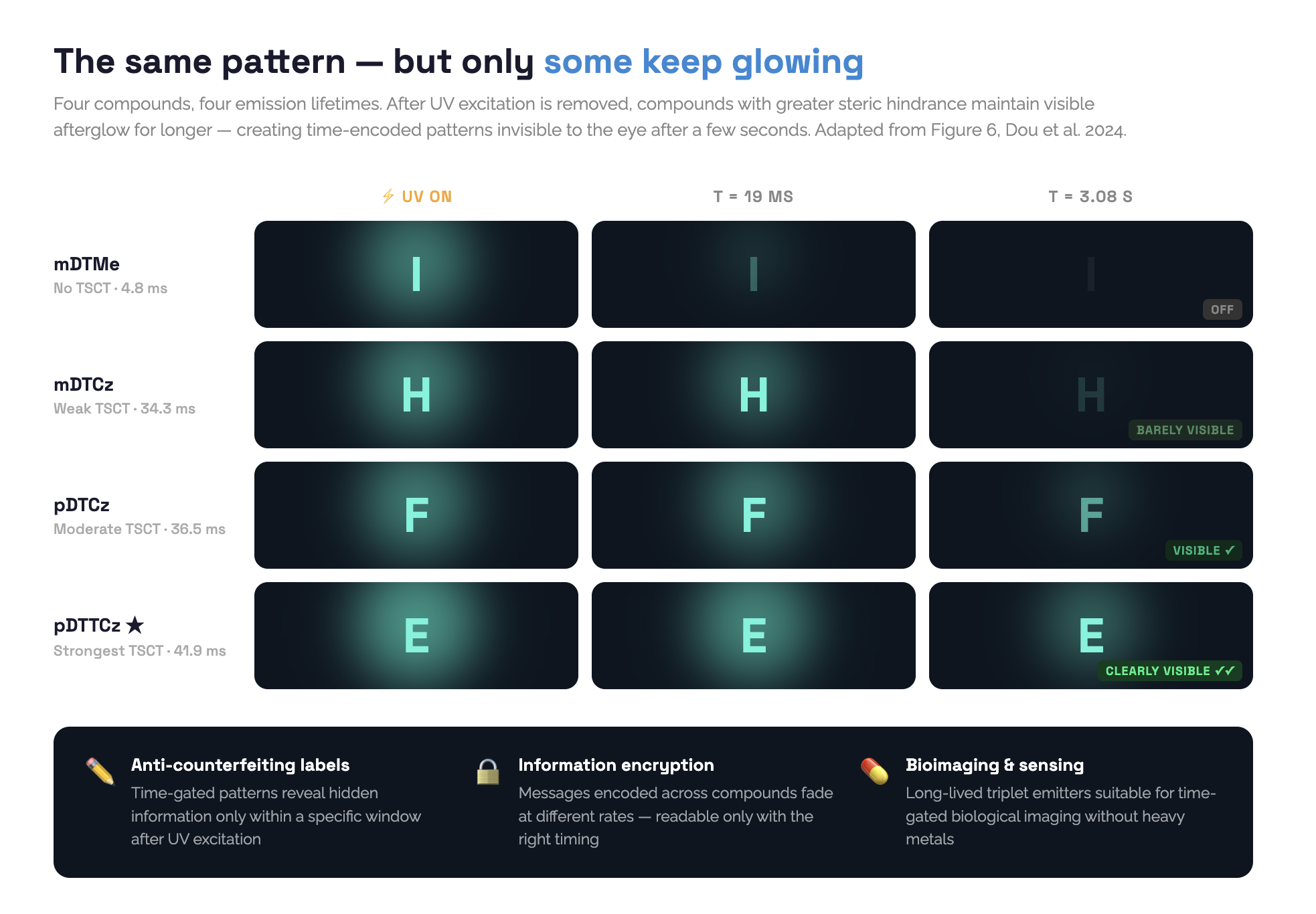
Figure 6. Time-dependent afterglow patterns: each compound fades at a different rate after UV excitation is removed, enabling time-encoded anti-counterfeiting and data security applications. Adapted from Dou et al. (2024), Fig. 6.
The time-dependent luminescent patterns demonstrated in this study - where different compounds fade at measurably different rates - point directly to practical applications in anti-counterfeiting, data security, and time-gated bioimaging.
But turning a result like this into a product requires more than knowing the molecule works. It requires:
Reliable, scalable synthetic access to the compound
The ability to make structural variants quickly - different lifetimes, different emission colours, different processing properties
Confidence that starting materials are commercially available and routes are cost-effective at scale
ChemAIRS addresses all three. The two routes it identified for pDTTCz both start from commercial materials. The modular structure of Route 1 makes variant synthesis straightforward. And the convergent efficiency of Route 2 reduces the step count for scale-up.
The researchers established the molecular design. ChemAIRS generated viable synthetic routes from commercial starting materials - a starting point for anyone wanting to make or iterate on this compound.
Working on Functional Organic Materials?
Whether you're developing emitters for OLEDs, probes for bioimaging, dyes for solar cells, or novel stimuli-responsive materials - if your work involves synthesizing complex organic targets, ChemAIRS can accelerate it.
ChemAIRS can reduce the time spent on synthesis planning, particularly for novel targets without literature precedent.
Request a demo tailored to your materials research at chemical.ai
Or reach out to our science team directly - we work with materials scientists, not just pharma.
References
1. Zhao, W., He, Z. & Tang, B.Z. Room-temperature phosphorescence from organic aggregates. Nat Rev Mater. 2020, 5, 869.
2. Song, J. et al. Reversible Multilevel Stimuli-Responsiveness and Multicolor RTP Emission. Angew. Chem. Int. Ed. 2022, 61, e202206157.
3. Gu, L. et al. Circularly Polarized Organic Room Temperature Phosphorescence from Amorphous Copolymers. J. Am. Chem. Soc. 2021, 143, 18527.
4. Dou, D. et al. Intramolecular Through-Space Charge-Transfer Effect for Achieving RTP in Amorphous Film. Adv. Optical Mater. 2024, 12, 2400976.
5. Zhao, J. et al. Triplet Photosensitizers: From Molecular Design to Applications. Chem. Soc. Rev. 2013, 42, 5323.
6. Theiss, T. et al. Room-Temperature Phosphorescence from Pd(II) and Pt(II) Complexes. J. Am. Chem. Soc. 2023, 145, 3937.
7. Baryshnikov, G., Minaev, B. & Ågren, H. Theory and Calculation of the Phosphorescence Phenomenon. Chem. Rev. 2017, 117, 6500.