

AI-Powered Chemistry Tools for Medicinal Chemists

Ideation Beyond Search
AI Retrosynthesis for Medicinal Chemists: Design Synthetic Routes for Novel Analogs
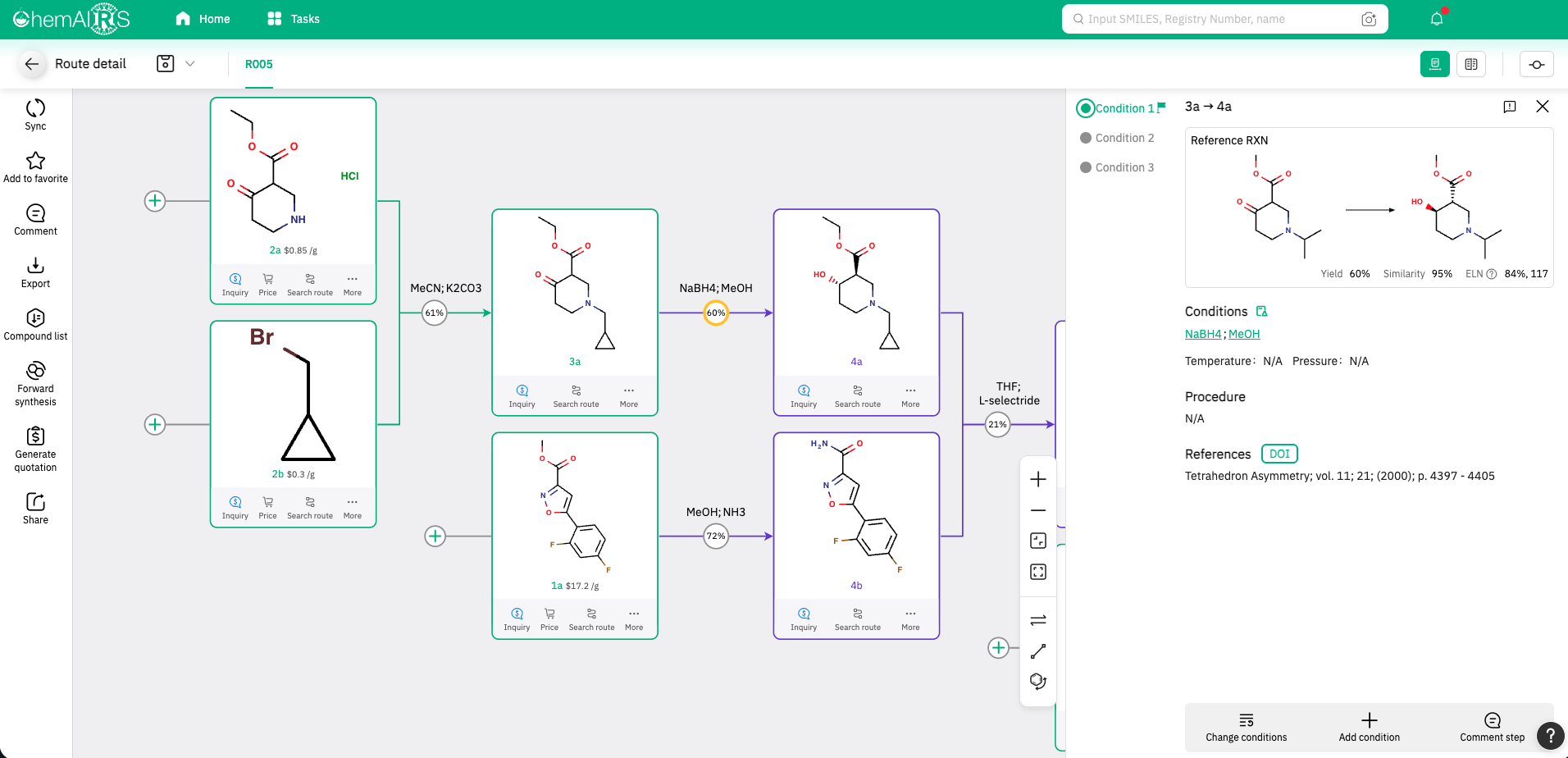
A new analog rarely has a close literature match, so route planning means piecing together precedent from related chemistry. ChemAIRS® reduces synthesis planning time by approximately 90%: literature search drops from 3–5 days to 30 seconds, and route brainstorming from 2–3 days to 2–4 minutes. Each search returns 10 to 50 AI-ranked routes to compare before you commit bench time.
Retrosynthesis for Medicinal Chemists
-
Retrosynthesis in drug discovery means working backward from a target molecule to the starting materials and reaction steps needed to build it. For medicinal chemists, this usually means finding a route to a new analog that hasn’t been made before, using known reactions as building blocks even when no direct literature precedent exists.
-
AI retrosynthesis software like ChemAIRS® ranks routes with a difficulty score that combines the number of linear steps with how closely each proposed reaction resembles known, precedented chemistry. Each search returns 10 to 50 prioritized routes. With local deployment, routes can also be ranked using your internal ELN data.
-
ChemAIRS® AI retrosynthesis draws on more than 61 million reactions from patents (including USPTO and EPO), open-source published literature and Chemical.AI’s curated proprietary datasets. It combines AI with curated rules, giving reliable coverage of known chemistry and predictive capability for novel molecules.
Retrosynthesis in Practice:
Route Design for Daraxonrasib (RMC-6236)
RAS(ON) inhibitor: two viable routes, one with 8 steps
Read the case study Newly Approved DrugRoute Design for Zidesamtinib (NVL-520)
TRK-sparing ROS1 inhibitor: two proposed routes, including an 8-step synthesis
Read the case study 9 Steps → 4Route Design for Sonrotoclax (BGB-11417)
Late-stage head group installation
Read the case studyForward Synthesis for Analog Design and SAR Exploration
Medicinal chemistry means exploring many analogs around a promising lead.
With ChemAIRS®, you start with a lead, scaffold, or target molecules and generate new analogs through synthetic routes, guided by structural or pharmacophore similarity.
-
Start from a lead, scaffold or target and ChemAIRS generates analogs together with the synthetic routes to make them. Users can:
Define chemistry. Set the scaffold or target, reaction types, reaction sites, and number of steps (1–6 steps, 50+ reaction types).
Hop scaffolds. Scaffold-based design and scaffold hopping are supported.
Set property ranges. MW, HBD, HBA, LogP, TPSA, and rotatable bonds.
-
ChemAIRS® Forward Synthesis starts with a lead, scaffold or target molecules and generates new analogs through synthetic routes, guided by structural or pharmacophore similarity. This helps medicinal chemists explore chemical space around a promising lead and generate new ideas for SAR studies. Because molecular design is connected to proposed synthetic routes, you can identify analogs worth further evaluation.
Synthetic Accessibility for Medicinal Chemists
A complex-looking molecule can be a short synthesis, and a simple-looking one can be a long one. Structure alone doesn’t tell you which.
With ChemAIRS®, you score an entire analog series in a single run, before synthesis begins. Each score comes with AI-ranked retrosynthetic routes
-
ChemAIRS® SA Score estimates synthetic accessibility using experimentally reported synthesis step counts from more than 1.5 million drug-like molecules, going beyond structural complexity alone. It helps medicinal chemists assess potential synthesis difficulty across an analog series before laboratory work.
Each score is accompanied by AI-ranked retrosynthetic routes, helping chemists compare compounds and evaluate their potential synthetic accessibility through the following capabilities:
Score the whole series in one run. Get a score for every analog before synthesis begins.
See the effort to make each one. 0 means commercially available; higher scores mean longer, more complex syntheses.
Choose between analogs with similar activity. Compare compounds with similar activity by how hard they are to make.
See the route behind every score. Each score comes with AI-ranked retrosynthetic routes.
Add synthetic accessibility to your SAR discussion at the design stage, not at the bench
-
To prioritize analogs for SAR studies, score the whole series with ChemAIRS® SA Score, then compare compounds with similar predicted activity by how hard each is to make. A lower score generally points to a shorter synthesis, and the attached routes show why. Weigh this alongside biological activity and chemical properties.
SA Score in Practice:
Featured Case Study for Medicinal Chemists
An example where route design and impurity prediction worked together on a real target.
Ready to optimize your synthesis strategies?
Join the leading chemists, pharma companies, and CROs using ChemAIRS to accelerate discovery, improve efficiency, and reduce costs.