
A Resistance Mutation With a Known Address: The BCL2 G101V Mutation and Venetoclax Resistance
Venetoclax transformed the treatment of chronic lymphocytic leukemia (CLL), but continuous therapy selects for escape. Roughly half of patients with progressive disease on venetoclax acquire the BCL2 Gly101Val (G101V) mutation, which cuts venetoclax affinity ~180-fold while leaving BH3-only protein binding largely intact [1, 2]. Unusually for an acquired resistance mechanism, the failure has a precise structural cause, which gave drug hunters a tractable design problem rather than a fishing expedition.
Sonrotoclax (BGB-11417), from BeiGene (now BeOne Medicines), is the result. It inhibits the BCL2:BAK interaction with an IC₅₀ of 0.014 nM, a 14-fold gain over venetoclax, with 2000-fold selectivity over BCL-xL versus 325-fold for venetoclax, the selectivity axis that determines platelet toxicity. Against the G101V mutant it retains a KD of 0.24 nM, where venetoclax falls to 29 nM [2].
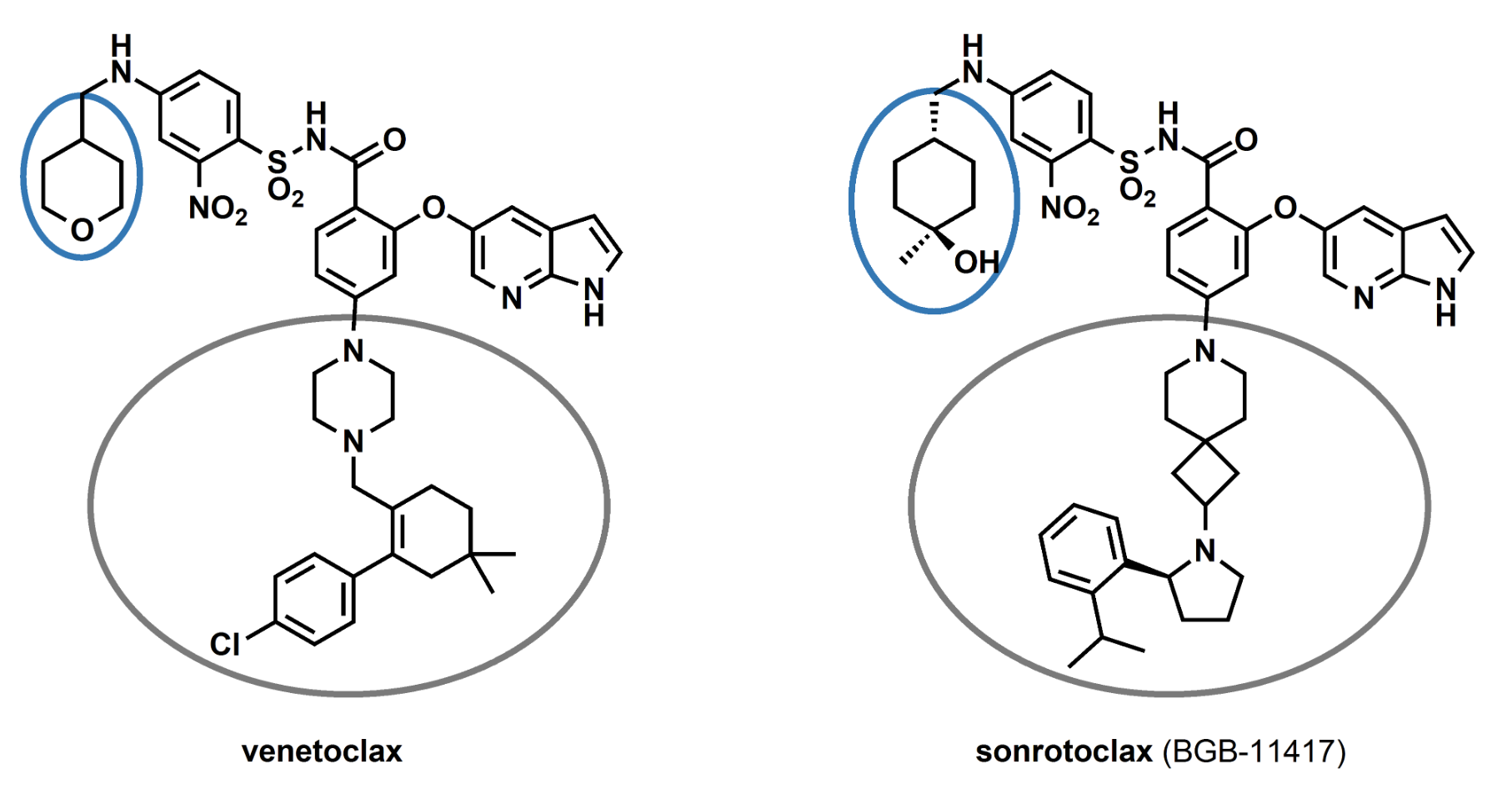
Figure 1 The chemical structures of venetoclax and sonrotoclax (BGB-11417), highlighting the divergent P2-directed headgroup (grey) and the C-terminal cyclohexanol tail (blue).
Sonrotoclax (BGB-11417) Discovery: From Venetoclax to a G101V-Active BCL2 Inhibitor
The BH3-mimetic lineage runs ABT-737 → navitoclax → venetoclax, each step fixing the previous compound's limiting defect: oral bioavailability first, then BCL-xL-driven thrombocytopenia, solved by engineering BCL2 selectivity into venetoclax. Venetoclax reached FDA approval in 2016 and became standard of care in CLL [1].
Its liability is the same feature that gives it potency. Venetoclax drives a chlorophenyl group deep into the BCL2 P2 pocket; when Gly101 becomes the bulkier valine, an adjacent glutamate is displaced into the base of that pocket and clashes with the buried aryl group [2, 3]. The design hypothesis for a successor was therefore explicit: engage P2 shallowly and broadly rather than deeply, and the displacement has nothing to collide with [3].
Sonrotoclax has cleared its first efficacy readout: phase 2 monotherapy in relapsed/refractory CLL/SLL met its primary endpoint with an IRC-assessed overall response rate of 76.0%, and no clinical tumour lysis syndrome occurred [4]. It is currently in phase 3 in treatment-naive CLL, in combination with zanubrutinib, against venetoclax-containing comparators [5, 6].
Sonrotoclax vs. Venetoclax: Chemical Structure and Synthetic Challenge
The chemical structure of sonrotoclax keeps the venetoclax P4-binding half (an oxygen-linked 7-azaindole and a nitrophenyl sulfonamide) and rebuilds everything else. Three motifs define the synthetic problem:
A 7-azaspiro[3.5]nonane linker, replacing venetoclax's piperidine. Rigid, and the element that fixes the headgroup vector.
An (S)-2-(2-isopropylphenyl)pyrrolidine headgroup. A single stereocentre on an ortho-substituted 2-arylpyrrolidine. Both the ortho position and the specific alkyl size are load-bearing, so neither is negotiable for synthetic convenience.
A trans-4-(aminomethyl)-1-methylcyclohexan-1-ol tail, which replaced a tetrahydropyran to eliminate CYP inhibition. The cis isomer performs worse against G101V, so the relative configuration must be controlled [3].
The head group determines P2 engagement and is therefore the element a medicinal chemistry team is most likely to want to vary. A route that commits to it early makes every analog an independent campaign.
ChemAIRS® Retrosynthetic Analysis of Sonrotoclax: From 9 Steps to 4
The disclosed route to sonrotoclax proceeds in nine steps overall, with a longest linear sequence of six steps [7]. ChemAIRS® proposed an alternative that assembles sonrotoclax convergently and defers installation of the head group to the end of the route, reaching the target in four steps overall with a longest linear sequence of three (Scheme 1). The route provides a highly modular approach to the target, leverages the commercial availability of complex building blocks, and every step proceeds under mild conditions.
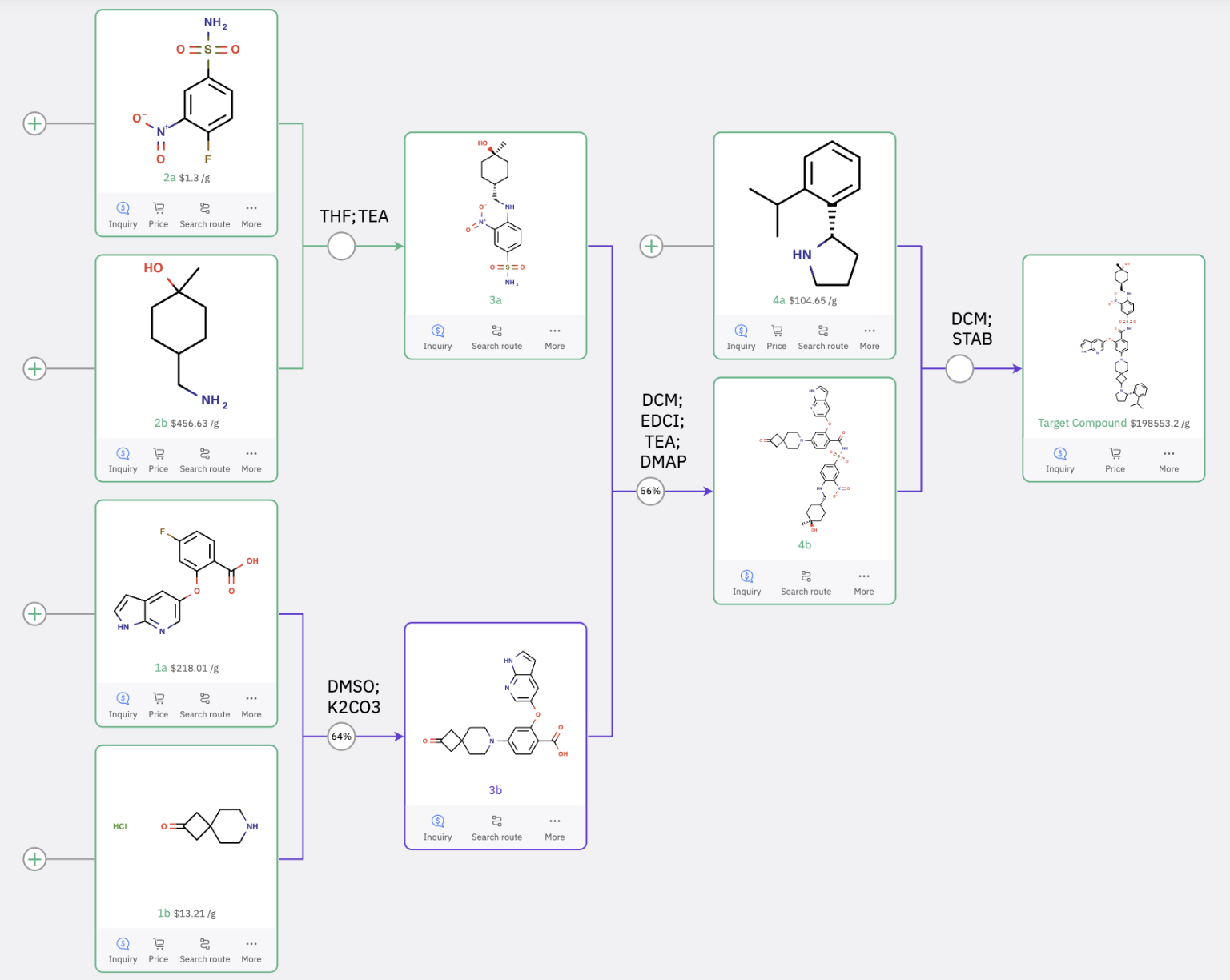
Scheme 1 ChemAIRS®-driven retrosynthetic analysis of sonrotoclax (BGB-11417)
The proposed synthesis begins with an SNAr reaction to couple 4-fluoro-3-nitrobenzenesulfonamide 2a with cyclohexanol derivative 2, affording the required trans diastereomer of 3a after chromatography. A separate SNAr reaction between aryl fluoride 1a and the hydrochloride salt of 7-azaspiro[3.5]nonan-2-one (1b) is used to assemble intermediate 3b, which could be coupled with 3a using EDCI to furnish 4b.
The (S)-2-(2-isopropylphenyl)pyrrolidine head group 4a is commercially available, and could be introduced under standard reductive amination conditions with STAB as the reducing agent. By installing the head group last, a team screening alternative P2 binders could carry one batch of advanced material forward and diversify at the end, rather than re-running a linear route for each analog.
About ChemAIRS®: An AI-Powered Retrosynthesis Platform
ChemAIRS® is Chemical.AI's AI-powered retrosynthesis platform. Instead of only searching literature and patents for routes that already exist, it generates and ranks new synthetic disconnections directly - ideation beyond search. Medicinal and process chemistry teams use it to work through exactly the kind of problem this article describes: a route that's technically valid but longer or less flexible than it needs to be.
The sonrotoclax route above is one example. On a separate program, Novalix used ChemAIRS® to work through a synthetic bottleneck on a key intermediate in one of its medicinal chemistry projects, identifying a single-step route the team hadn't converged on and confirming it experimentally on its high-throughput experimentation (HTE) platform. Read Novalix’s full post.
Sonrotoclax Synthesis: From Nine Steps to Four
ChemAIRS® proposes a synthetic route to cut the synthesis of sonrotoclax from nine steps to four. It did this using building blocks that are already commercially available, so fewer steps also means less time spent sourcing and preparing material at the bench. The key strategic move was installing the head group last instead of carrying it through the whole synthesis. That single change is what makes the route modular, since a team can swap in a different P2 binder at the final step rather than rerunning the sequence for each new analogue.
References
Liu, J.; Li, S.; Wang, Q.; et al. Sonrotoclax Overcomes BCL2 G101V Mutation–Induced Venetoclax Resistance in Preclinical Models of Hematologic Malignancy. Blood2024, 143 (18), 1825–1836. https://doi.org/10.1182/blood.2023019706
Vogler, M.; Braun, Y.; Smith, V. M.; et al. The BCL2 Family: From Apoptosis Mechanisms to New Advances in Targeted Therapy. Signal Transduct. Target. Ther.2025, 10, 91. https://doi.org/10.1038/s41392-025-02176-0
Guo, Y.; Xue, H.; Hu, N.; et al. Discovery of the Clinical Candidate Sonrotoclax (BGB-11417), a Highly Potent and Selective Inhibitor for Both WT and G101V Mutant Bcl-2. J. Med. Chem.2024, 67, 7836–7858. https://doi.org/10.1021/acs.jmedchem.4c00027
Yi, S.; Zhou, K.; Liu, N.; et al. Primary Analysis of a Multicenter, Open-Label, Phase 2 Study of Sonrotoclax (BGB-11417) Monotherapy in Patients with Relapsed/Refractory CLL/SLL. Blood2025, 146 (Suppl. 1), 5666–5667. https://doi.org/10.1182/blood-2025-5666
BeOne Medicines. Study of Sonrotoclax (BGB-11417) Plus Zanubrutinib (BGB-3111) Compared With Venetoclax Plus Obinutuzumab in Participants With Chronic Lymphocytic Leukemia (CLL); Identifier NCT06073821. ClinicalTrials.gov. https://clinicaltrials.gov/study/NCT06073821 (accessed 2026-07-24)
BeOne Medicines. A Study to Investigate Sonrotoclax (BGB-11417) Plus Zanubrutinib (BGB-3111) Compared With Venetoclax Plus Acalabrutinib in Adults With Previously Untreated Chronic Lymphocytic Leukemia; Identifier NCT07277231. ClinicalTrials.gov. https://clinicaltrials.gov/study/NCT07277231 (accessed 2026-07-24)
Guo, Y. H.; Xue, H.; Wang, Z. W.; Sun, H. Z. Bcl-2 Inhibitors. WO 2019210828 A1, 2019.