

AI-Powered Chemistry Tools for Computational Chemists
Bring Synthesis Feasibility into Virtual Screening

AI Synthesizability Screening for Virtual Libraries: Rank Candidates by Synthetic Accessibility
Virtual screening and generative design produce thousands of candidates, and computationally interesting molecules are not always straightforward to make. ChemAIRS® scores the synthetic accessibility of hundreds of thousands of molecules in hours: submit a library in the evening and have ranked results the next morning, each with AI-ranked retrosynthetic routes. Synthesizability becomes a property you rank by, not a filter applied afterward.
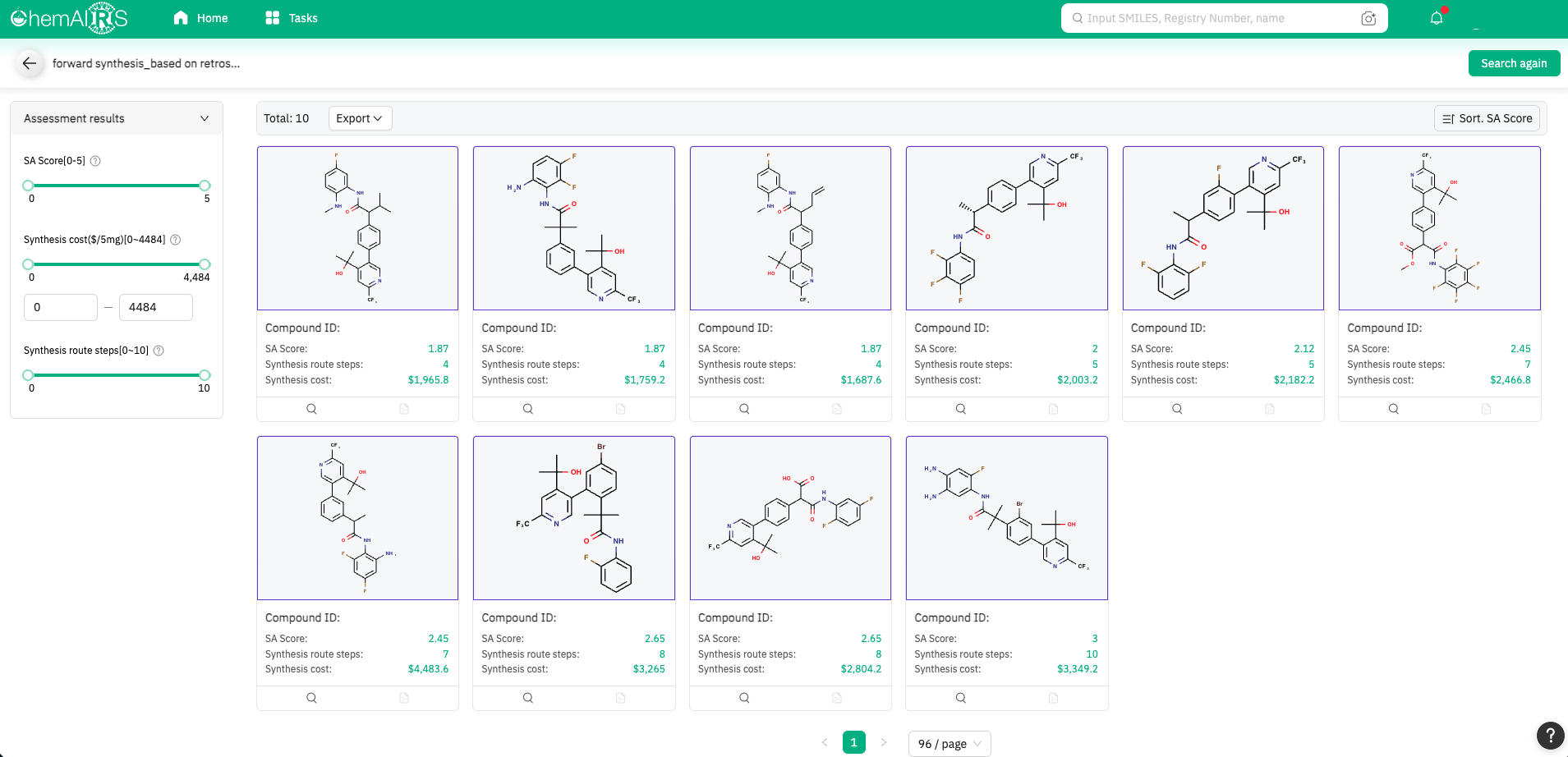
Forward Synthesis for Computational Chemists
Start from a core or scaffold and let ChemAIRS® build the library through real synthetic routes. Every compound comes with a route, so there is no separate synthesizability check at the end. Libraries range from thousands to more than 10,000 compounds, depending on search settings.
-
ChemAIRS® makes synthetic feasibility part of the generation process, not an evaluation afterward. Libraries reach thousands to more than 10,000 compounds from a defined starting point, depending on search settings. Users can:
Build synthesis into generation. The defined core enters the route as a building block.
Work within defined chemistry constraints. Libraries are built using the building blocks your team actually has access to.
Use the library downstream. Take it into docking or other property screening.
-
ChemAIRS® Forward Synthesis helps computational chemists explore target-focused chemical space by generating diverse molecular candidates around a defined core or scaffold. You can:
Constrain the search. Set reaction types, number of steps, reaction sites, and property ranges.
Guide by similarity. Use structural or pharmacophore similarity to retain relevant molecular features while exploring new structures.
The resulting libraries support hit exploration, scaffold hopping, and prioritization of compounds for further computational analysis and experimental evaluation.
Synthetic Accessibility Score for Computational Chemists
A docking score tells you how well a molecule might bind. It doesn’t tell you whether anyone can make it.
Synthetic accessibility becomes another property you rank by, next to docking scores. Every score comes with AI-ranked retrosynthetic routes, so you can see why a molecule scored the way it did.
-
A docking score tells you how well a molecule might bind, but not whether anyone can make it. With ChemAIRS®, synthetic accessibility becomes another property you rank by, next to docking scores.
Score large libraries overnight. Hundreds of thousands of molecules are evaluated in hours: submit a library in the evening and have scored results the next morning.
Screen in one batch. SA Score Super Fast Mode screens up to 1 million molecules in a single batch.
See what’s behind each score. Every score comes with AI-ranked retrosynthetic routes.
A score of 5 doesn’t mean impossible. SA Score ranges from 0 to 5, and even a score of 5 doesn’t mean a compound can’t be synthesized. Explore alternative synthetic routes with Retrosynthesis
-
Virtual screening and AI-driven molecular generation can produce thousands of candidate compounds, but promising predicted properties do not necessarily translate into practical synthesis. ChemAIRS® SA Score adds synthetic accessibility to compound evaluation, so researchers can compare candidates by predicted performance and by the potential effort required to synthesize them. The score is calculated from retrosynthesis rules rather than chemical similarity, and it serves as a prioritization tool, not a yes-or-no gate.
SA Score in Practice:
See ChemAIRS® on Your Own Virtual Library
Screen for synthesizability before you screen for anything else.