
ChemAIRS® vs SYNTHIA®
ChemAIRS® vs SYNTHIA®: Which Retrosynthesis Platform Is Right for You?
If you're evaluating computer-aided retrosynthesis tools, both ChemAIRS and SYNTHIA are likely on your shortlist. Both are mature platforms used across the pharmaceutical industry, and both will generate viable synthetic routes for your target molecules.
So how do you choose?
The answer depends entirely on the type of chemistry problem you are trying to solve. This post breaks down the fundamental differences in how these platforms operate, where each excels, and where they encounter limitations.
Rule-Based vs Machine Learning Retrosynthesis: How SYNTHIA® and ChemAIRS® Work
The fundamental difference between these platforms is how they are engineered to propose a route.
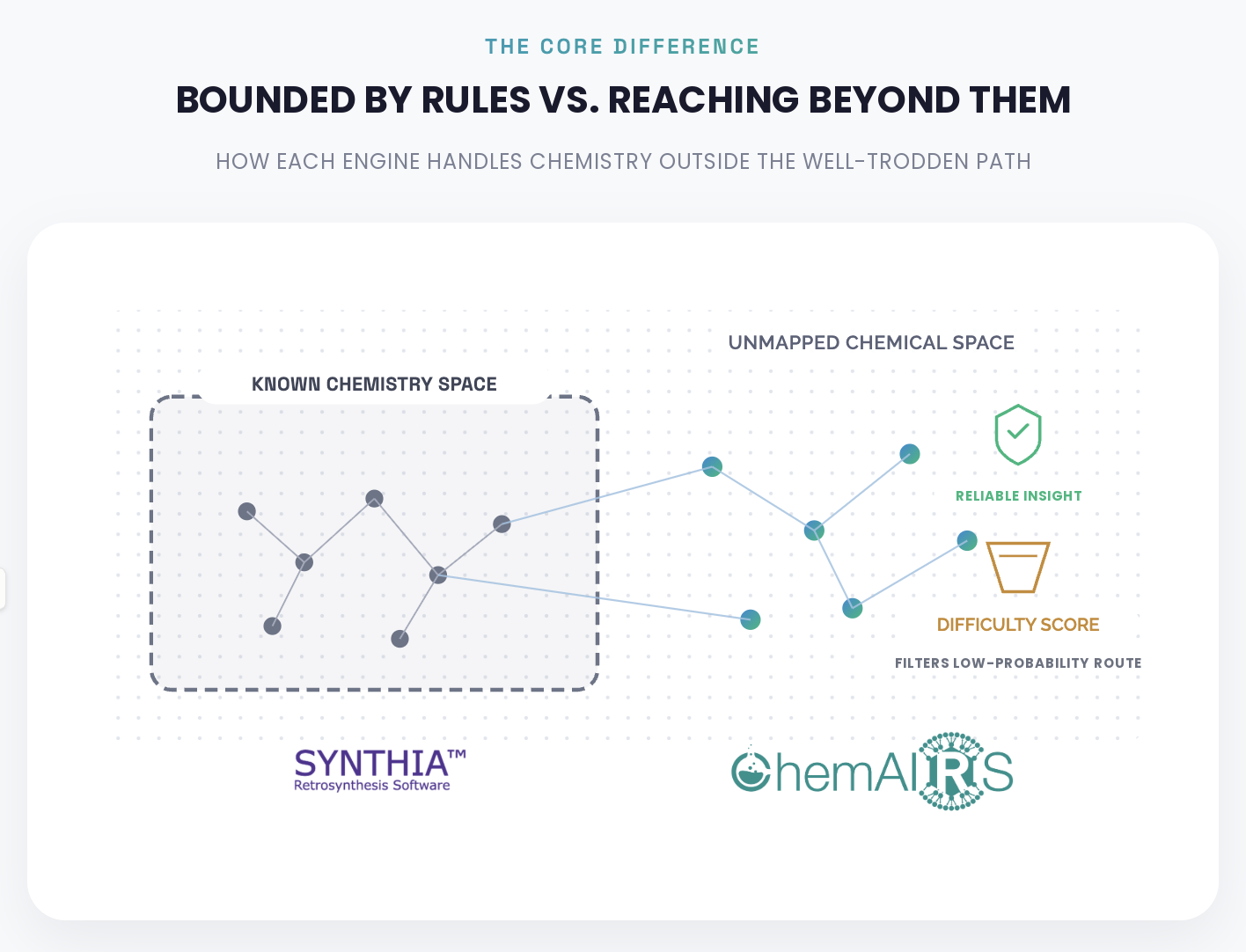
Figure 1: Rule-Based vs. Machine Learning Retrosynthesis, SYNTHIA® vs. ChemAIRS®
SYNTHIA®'s Rule-Based Retrosynthesis Approach
SYNTHIA relies on over 100,000 transformation rules hand-coded by expert chemists over two decades. It is interpolative: exceptionally reliable for known chemistry, with very low risk of proposing a chemically impossible mechanism. The ceiling, however, is the library of rules itself: if a transformation hasn't been explicitly coded, the system cannot discover it.
ChemAIRS®'s Machine Learning Approach to Retrosynthesis
ChemAIRS, while also using chemistry rules, combines deep learning algorithms with chemical intuition, deriving synthetic pathways from vast datasets. Because it isn't constrained by only literature searches or by only a fixed rule library, it can propose novel disconnections for complex or unconventional targets. The inherent trade-off is that a machine learning model can occasionally suggest routes that are difficult to execute on the bench. This is why ChemAIRS builds a Difficulty score directly into the retrosynthesis engine, filtering out low-probability routes before a chemist spends time reviewing them.
Neither SYNTHIA nor ChemAIRS is universally superior. The choice comes down to whether you need deep reliability within well-mapped chemistry or predictive reach into uncharted space.
When to Use SYNTHIA® for Small Molecule Retrosynthesis?
SYNTHIA's rule-based engine is highly effective for standard small molecule synthesis. If your targets are conventional drug-like compounds with well-precedented scaffolds and established disconnections, the platform finds routes quickly and with high chemical sanity. Its catalogue of over 12 million commercially available building blocks makes it straightforward to check sourcing alongside route planning. For organizations already embedded in the Dotmatics ecosystem, the dedicated connector with Dotmatics Luma™ allows chemists to evaluate pathways directly within their native ELN workflow.
ChemAIRS® Retrosynthesis Use Cases by Role
Medicinal Chemistry: Heterobifunctional Molecules, Macrocycles, and Novel Heterocycle Synthesis
Modern drug discovery frequently moves beyond conventional small molecules into heterobifunctional molecules, macrocycles, covalent binders, and novel heterocycles. These are targets that challenge purely rule-based tools because the relevant transformations haven't been hand-coded. ChemAIRS operates without a rule-library ceiling, proposing pathways for entirely novel structures. Additionally, its built-in SA Score evaluates true synthesizability rather than structural complexity as a proxy and ranked first among major Computer-aided Synthesis Planning (CASP) platforms in independent benchmarking. You can read a detailed breakdown of the benchmark here: the SA Score blog.
Synthesizable Virtual Library Design for Computational Chemists
Virtual library enumeration often generates thousands of compounds that score well in silico but prove impractical to synthesize. The ChemAIRS Forward Synthesis module embeds synthesizability constraints directly into the library generation phase, ensuring virtual libraries contain only compounds with realistic, executable pathways.
Process Chemistry Scale-Up and Impurity Prediction
Most retrosynthesis platforms stop at early-stage discovery. The ChemAIRS Process Chemistry module integrates scale-up economics, bulk sourcing constraints, and access to an extensive supplier network directly into the route design stage. An additional Impurity Prediction module identifies potential byproducts before a pilot run, allowing teams to lock in commercially viable pathways early and minimize late-stage re-optimization.
Bayesian Optimization for Reaction Conditions
Finding the ideal combination of catalyst, solvent, temperature, and time is traditionally a slow, resource-intensive process of trial and error. The ChemAIRS Bayesian Optimization module analyzes data from completed reactions to propose the next most promising experimental conditions, maximizing desired results (e.g., conversion, yield) with a fraction of the physical experiments and saving valuable starting materials and time.
On-Premises vs Cloud Deployment for Data Security
For enterprise IT and legal teams, ChemAIRS provides the flexibility to match your organization's infrastructure and security policies, offering both cloud-hosted and on-premises options. The local option keeps proprietary structures and reaction data entirely within your corporate firewall, with direct integration into internal ELNs and reagent inventories. For organizations looking to avoid local hardware maintenance, the cloud-hosted version delivers full performance without the IT overhead.
ChemAIRS® vs SYNTHIA®: Which Fits Your Synthesis Workflow?
SYNTHIA is a robust option for teams working primarily in well-precedented small molecule space, particularly those already operating within the Dotmatics ecosystem.
ChemAIRS handles standard small molecule work, while extending into complex modalities that require more than a hand-coded ruleset. With forward synthesis, process chemistry, impurity prediction, and Bayesian optimization integrated into a single platform, the question isn't just which retrosynthesis algorithm you prefer: it's how much of your synthesis pipeline you want to manage in one place.
The most direct way to evaluate fit is to test it against a real project. Bring a target from your current workflow to a technical demo and see how the platform handles your specific modality, sourcing constraints, and optimization needs.
ChemAIRS® is a registered trademark of Chemical.AI Inc. All rights reserved
SYNTHIA® is a registered trademark of Merck KGaA, Darmstadt, Germany and/or its affiliates
Luma™ is a trademark of Dotmatics Limited
References
SYNTHIA transformation rule count: https://www.synthiaonline.com/resources/white-paper/computational-analysis-of-synthetic-planning-past-and-future
SYNTHIA commercially available building blocks catalogue (12 million): https://www.sigmaaldrich.com/CA/en/services/software-and-digital-platforms/synthia-retrosynthesis-software