
Synthesis of Vepdegestrant (ARV-471): ChemAIRS® Route Design for the First Approved PROTAC
Vepdegestrant (ARV-471): The First PROTAC to Reach the Market
On May 1, 2026, the FDA approved vepdegestrant (ARV-471, marketed as Veppanu) for adults with estrogen receptor (ER)-positive, HER2-negative, ESR1-mutated advanced or metastatic breast cancer whose disease has progressed after at least one line of endocrine therapy, together with a companion diagnostic that calls ESR1 mutations from circulating tumor DNA.1 The agency cleared the application a month ahead of its goal date.
It is the first proteolysis-targeting chimera (PROTAC) ever approved.2 The modality was introduced in 2001 as a peptide-based proof of concept,3 and twenty-five years later it has a marketed small-molecule drug. For synthetic chemists, the more interesting fact is what that drug looks like: a 724 Da heterobifunctional molecule carrying three defined stereocenters and a calculated logP of 6.8, sitting comfortably outside rule-of-five space.4
ER-Positive Breast Cancer Treatment Resistance: ESR1 Mutations and Endocrine Therapy Failure
Roughly 70% of newly diagnosed breast cancers are ER-positive, and their growth is driven by estrogen signalling through ERα.4 Standard endocrine-based treatment works well but can eventually fail in several ways, including:
Activating ESR1 mutations, which allow ligand-independent coactivator binding and reduce sensitivity to aromatase inhibitors, SERMs, and SERDs alike.5
Delivery problems with fulvestrant, the reference SERD, which has poor solubility and no useful oral bioavailability. This forces 500 mg intramuscular dosing, and it eliminates only part of the receptor pool.
Resistance to CDK4/6 inhibitors, which does not remove ER dependence. Many tumours that progress on a CDK4/6 inhibitor continue to run on ER-driven transcription, so the upstream driver is still there to be removed.4
PROTACs give drug hunters a way around the “occupancy problem”, where a drug’s effect depends on keeping the binding site filled. Rather than binding the receptor and holding it, a PROTAC recruits an E3 ligase, triggers ubiquitination and proteasomal destruction of the target, then dissociates and does it again. The pharmacology is event-driven and catalytic instead of stoichiometric, and it does not care what conformation the receptor has adopted, which is precisely why ESR1 mutants remain vulnerable.
Analyzing the Structure of Vepdegestrant (ARV-471)
Vepdegestrant is assembled from three key fragments. The ER-binding end is a bulky cis-1,2-diaryltetralin derived from the SERM lasofoxifene, built on a 6-hydroxytetrahydronaphthalene core selected for high-affinity binding to both wild-type and mutant ligand-binding domains. The cereblon-recruiting end is a glutarimide-isoindolinone motif derived from lenalidomide. Between them sits a deliberately rigid linker incorporating a piperazine, chosen to constrain the conformation of the PROTAC and thereby improve degradation efficiency and pharmacokinetic behaviour.

Figure 1 The chemical structure of vepdegestrant (ARV-471) with highlighted fragments derived from lasofoxifene (red) and lenalidomide (blue)
Retrosynthetic Analysis of Vepdegestrant: ChemAIRS® Route Design
Retrosynthetic analysis of vepdegestrant using ChemAIRS®’ Process Chemistry module returned a significant number of route ideas, several of which relied exclusively on known chemistry pieced together from different sources. An example of one of these ideas, comprising 16 known steps (LLS = 7 steps), is shown in Scheme 1. All of the raw materials used in this route are commercially available in kilo-scale quantities.

Scheme 1 ChemAIRS®-inspired retrosynthetic analysis of vepdegestrant (ARV-471), relying exclusively on known chemistry.
The bottom half of the synthesis tree almost exactly matches previously published strategies to obtain key intermediate 16b on manufacturing scale. Beginning with methyl benzoate derivative 3a, ChemAIRS followed the same three-step route to aldehyde 6a that was originally used to prepare this fragment during early clinical development,6 albeit retrieving reaction conditions from three alternative sources. The overall transformation of 1a to 6b, followed by reductive amination with 6a and cyclization to the glutarimide, with concomitant removal of the Boc group from the piperazine to afford 16b, closely resembles the approach used in the original manufacturing route to vepdegestrant.7

Scheme 2 ChemAIRS®-inspired synthesis of the cereblon-recruiting fragment (16b) of vepdegestrant (ARV-471)
The top half of the route, meanwhile, eventually arrives at aldehyde 16a by following a similar strategy to the original manufacturing route, with a notable exception being the choice to set the stereochemistry of the cis-tetralin 14b before attaching piperidine 14a.
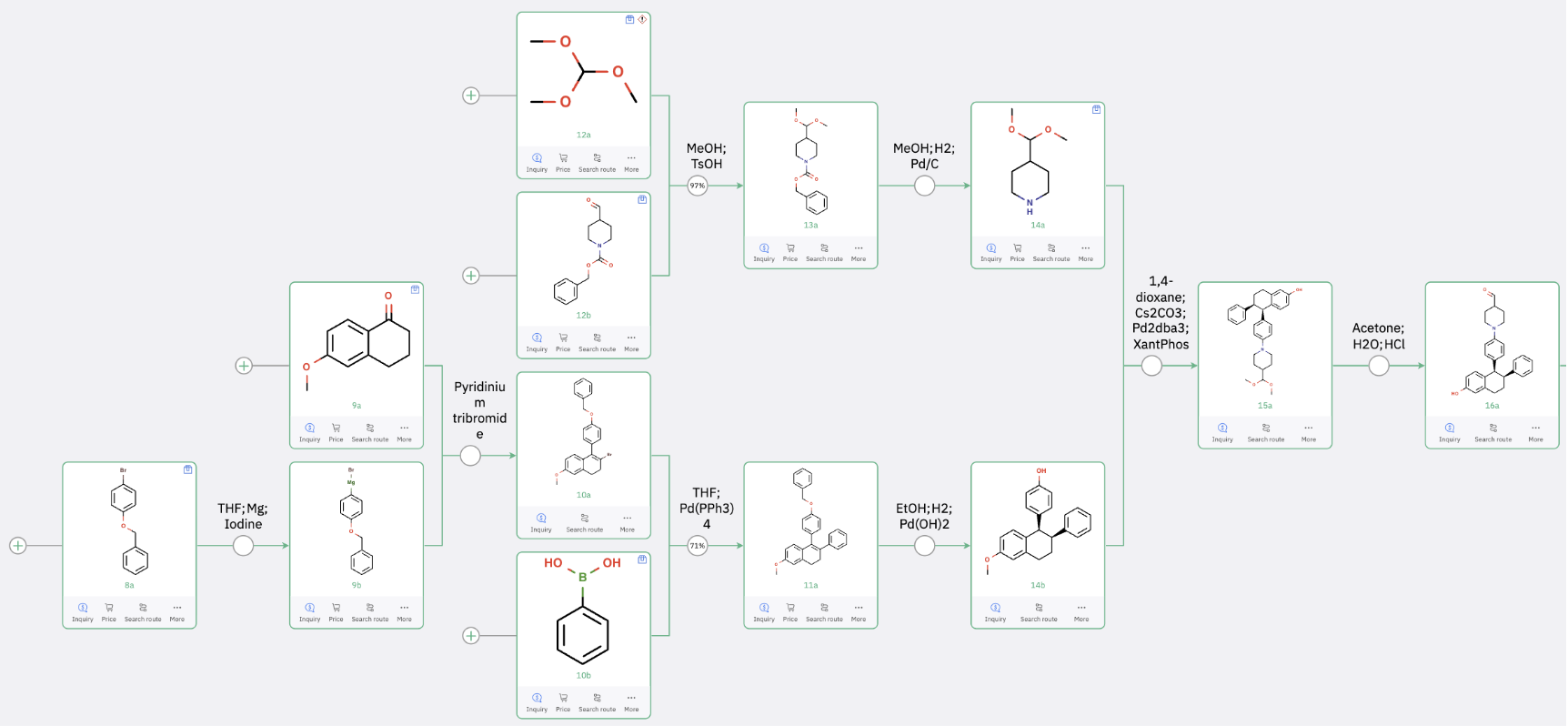
Scheme 3 ChemAIRS®-inspired synthesis of the cis-tetralin fragment (16a) of vepdegestrant (ARV-471)
Perhaps the most surprising thing about this strategy is that ChemAIRS® designed it almost completely independently of the reported manufacturing route,6a which is cited only once (for the synthesis of primary amide 2a).
What Is ChemAIRS®? A Computer-Aided Synthesis Planning Platform
ChemAIRS® is a computer-aided synthesis planning (CASP) platform that proposes retrosynthetic routes to existing and novel molecules, ranking them by feasibility and by access to readily available building blocks. Its Retrosynthesis module combines machine learning with encoded chemical logic, and every step remains open to interrogation, so chemists can troubleshoot a disconnection or explore alternative methodology rather than accept a route as given. The platform is built to extend a chemist's strategic reach, not to substitute for it.
Vepdegestrant Synthesis: A 16-Step Route to the First Approved PROTAC
ChemAIRS® reconstructed much of vepdegestrant's manufacturing strategy while barely consulting it. Working through the Process Chemistry module, the platform returned a convergent, 16-step route built entirely from known chemistry, reaching that strategy while citing the original manufacturing route only once. The cis-tetralin fragment 16a and the cereblon-recruiting fragment 16b are built on separate branches and converge late, each resting on commercial bulk raw materials and precedented transformations rather than any step that would have to be invented. Where the proposal parts from the manufacturing baseline is a single, deliberate choice: ChemAIRS® sets the cis-tetralin stereochemistry at 14b before attaching piperidine 14a, reversing the order of the reported route without deviating from established precedent.
For a molecule whose manufacturing route is already on record, the agreement between ChemAIRS® and process chemistry experts is a check on the platform's chemical judgment; for one whose route is not, the same independence hands a process team a credible starting point they would otherwise build from scratch.
References
FDA approves vepdegestrant for ER-positive, HER2-negative, ESR1-mutated advanced or metastatic breast cancer. US Food and Drug Administration. May 1, 2026. Accessed August 5, 2026. https://www.fda.gov/drugs/resources-information-approved-drugs/fda-approves-vepdegestrant-er-positive-her2-negative-esr1-mutated-advanced-or-metastatic-breast
Arvinas announces FDA approval of VEPPANU (vepdegestrant) for the treatment of ESR1m, ER+/HER2- advanced breast cancer. Arvinas, Inc. May 1, 2026. Accessed August 5, 2026. https://ir.arvinas.com/news-releases/news-release-details/arvinas-announces-fda-approval-veppanu-vepdegestrant-treatment/
Ma Z, Zhou J. NDA submission of vepdegestrant (ARV-471) to U.S. FDA: the beginning of a new era of PROTAC degraders. J Med Chem. 2025;68(14):14129-14136. https://doi.org/10.1021/acs.jmedchem.5c01818
Tang C, Tian B, Zhang B, et al. Insights into vepdegestrant (ARV-471): the first-in-class estrogen receptor proteolysis-targeting chimera approaching Food and Drug Administration approval for breast cancer. ChemMedChem. 2026;21:e202501111. https://doi.org/10.1002/cmdc.202501111
Rej RK, Thomas JE II, Acharyya RK, Rae JM, Wang S. Targeting the estrogen receptor for the treatment of breast cancer: recent advances and challenges. J Med Chem. 2023;66(13):8339-8381. https://doi.org/10.1021/acs.jmedchem.3c00136
a) Chen CH, Dong H, inventors; Arvinas Operations, Inc., applicant. Methods of Manufacturing a Bifunctional Compound. WIPO patent WO2023/009521A1. February 2, 2023. b) Bernhardson DJ, Fifer J, Girvin ZC, et al. A Second-Generation Route to the Cereblon Fragment of ARV-471, Vepdegestrant. Org. Process Res. Dev. 2025;29:2636-2648. https://doi.org/10.1021/acs.oprd.5c00271
Avery S, Buske JM, Chen D, et al. Development of a Commercial Manufacturing Process for Vepdegestrant, an Orally Bioavailable PROTAC Estrogen Receptor Degrader for the Treatment of Breast Cancer. Org. Process Res. Dev. 2024;28;4079. https://doi.org/10.1021/acs.oprd.4c00362